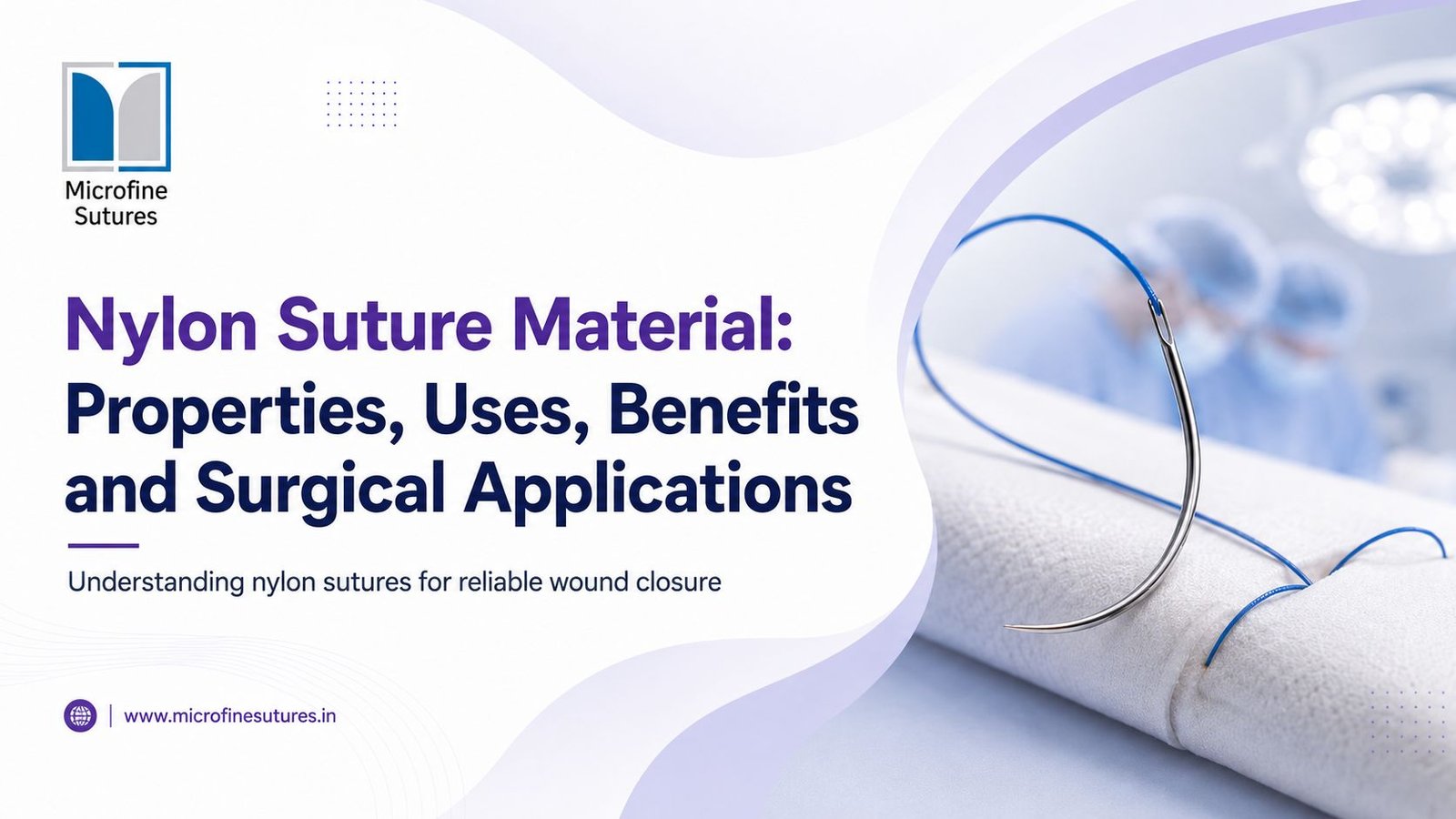
When selecting a surgical suture, the material plays an important role in wound closure, tissue response, handling characteristics and long-term support. Nylon suture material is one of the most widely used synthetic, non-absorbable suture materials for a variety of surgical procedures.
Known for its high tensile strength, smooth tissue passage and relatively low tissue reactivity, nylon sutures are commonly used for skin closure and other procedures where dependable wound approximation is required.
At Microfine Sutures, we focus on delivering reliable surgical suture solutions designed to meet the requirements of hospitals, surgeons, distributors and healthcare professionals.
What Is Nylon Suture Material?
Nylon suture material is a synthetic polyamide material used to manufacture non-absorbable surgical sutures. Nylon sutures are commonly available as monofilament sutures, although braided forms may also be manufactured for specific applications.
Because nylon is synthetic, it provides consistent physical properties and generally produces less tissue reaction compared with many natural suture materials.
Nylon sutures are typically used when prolonged wound support is required or when the surgeon plans to remove the suture after sufficient healing has occurred.
Key Properties of Nylon Suture Material
Nylon has several characteristics that make it suitable for surgical wound closure.
1. High Tensile Strength
Nylon suture material offers dependable tensile strength, helping maintain wound approximation during the healing period.
Its strength makes it suitable for procedures where secure closure is important.
2. Low Tissue Reactivity
As a synthetic material, nylon generally causes minimal tissue response when compared with some natural sutures.
This characteristic makes nylon an appropriate choice for many skin and soft-tissue applications.
3. Smooth Tissue Passage
Monofilament nylon has a smooth surface that allows the suture to pass through tissue with relatively low drag.
Reduced tissue drag can help minimize unnecessary tissue trauma during suturing.
4. Non-Absorbable Material
Nylon is classified as a non-absorbable surgical suture. It does not undergo rapid absorption inside the body like absorbable materials such as Polyglactin 910 or Polyglycolic Acid.
However, nylon may gradually lose some tensile strength over an extended period.
5. Good Handling Characteristics
Nylon sutures are lightweight and flexible, allowing surgeons to achieve accurate wound approximation.
Proper knotting technique is important because monofilament materials may require additional throws to maintain secure knots.
Common Uses of Nylon Sutures
Due to its versatility, nylon suture material is used across different surgical specialties.
Common applications may include:
- Skin closure
- General soft tissue approximation
- Plastic and reconstructive surgery
- Ophthalmic procedures
- Microsurgical applications
- Cardiovascular procedures in selected cases
- Neurosurgical applications
- Tendon or ligament repair depending on surgical requirements
The selection of any suture should always depend on the tissue involved, wound condition, required support period and surgeon preference.
Why Is Nylon Commonly Used for Skin Sutures?
One of the most common applications of nylon sutures is skin closure.
Skin wounds often require a material that offers sufficient strength while producing minimal tissue reaction. Monofilament nylon provides a smooth surface and low capillarity, making it suitable for external wound closure.
Once adequate healing has taken place, the sutures can generally be removed according to the surgeon’s clinical assessment.
This combination of strength, smoothness and controlled removal has made nylon a widely recognized material for skin suturing.
Monofilament Nylon Suture Advantages
Monofilament nylon consists of a single strand rather than multiple braided fibres.
This construction provides several benefits:
Reduced Tissue Drag
The smooth structure helps the suture pass easily through tissue.
Lower Capillarity
Because it does not contain multiple braided fibres, monofilament nylon has less potential for fluid movement along the suture structure.
Minimal Tissue Reaction
Synthetic monofilament construction generally promotes a relatively low inflammatory response.
Easy Removal
For external skin closure, nylon sutures can usually be removed after the wound has healed sufficiently.
Nylon Suture Material vs Absorbable Sutures
The main difference between nylon and absorbable sutures is how they behave after implantation.
Nylon sutures are non-absorbable and are primarily selected when prolonged support or later removal is required.
In comparison, absorbable sutures gradually break down inside the body and normally do not require manual removal.
For example:
| Feature | Nylon Suture | Absorbable Suture |
|---|---|---|
| Material Type | Synthetic | Synthetic or natural |
| Absorption | Non-absorbable | Gradually absorbed |
| Removal | May require removal | Usually not required |
| Common Application | Skin and long-term support | Internal soft tissue closure |
| Tissue Reaction | Generally low | Depends on material |
| Structure | Commonly monofilament | Monofilament or braided |
The appropriate suture should always be selected according to the clinical procedure and desired healing period.
Nylon vs Polypropylene Suture
Both nylon and polypropylene are synthetic, non-absorbable materials, but their handling and long-term performance differ.
Nylon is widely preferred for skin closure because of its smooth handling and strong initial tensile performance.
Polypropylene is also a monofilament suture material and is often selected where long-term tensile strength and minimal tissue interaction are especially important.
The surgeon’s choice depends on the tissue, duration of support and specific surgical indication.
Factors to Consider When Choosing Nylon Sutures
Before selecting a nylon suture, healthcare professionals generally consider factors such as:
- Suture size
- Needle type
- Needle curvature
- Tissue characteristics
- Wound location
- Required tensile support
- Surgical technique
- Duration before suture removal
- Patient-specific healing requirements
Selecting the correct needle and suture combination is as important as choosing the suture material itself.
Nylon Sutures from Microfine Sutures
Microfine Sutures provides surgical suture solutions for healthcare institutions, hospitals, distributors and medical supply partners.
Our focus is on dependable quality, consistent manufacturing and supplying suitable suture configurations for different surgical applications.
For businesses looking for a reliable nylon suture manufacturer or supplier, Microfine Sutures can support bulk procurement, distribution requirements and product-related enquiries.
We also work with healthcare businesses seeking reliable surgical suture supply for domestic and international markets.
Why Choose Microfine Sutures?
Choosing a dependable suture supplier is important because wound closure products require consistency in manufacturing, packaging and performance.
Microfine Sutures focuses on:
- Reliable surgical suture manufacturing
- Consistent product quality
- Multiple suture and needle configurations
- Bulk supply capabilities
- Support for hospitals and distributors
- International supply requirements
- OEM and private-label opportunities
Our goal is to support healthcare professionals and business partners with dependable surgical wound closure solutions.
Frequently Asked Questions About Nylon Suture Material
Is nylon suture absorbable?
No. Nylon is classified as a non-absorbable synthetic surgical suture material. It is commonly removed after healing when used externally.
What is nylon suture material made from?
Nylon sutures are manufactured from synthetic polyamide polymers.
Is nylon suitable for skin closure?
Yes. Nylon is widely used for skin closure because of its high tensile strength, smooth surface and relatively low tissue reactivity.
Is nylon suture monofilament or braided?
Nylon can be produced in different constructions, but monofilament nylon sutures are widely used in surgical practice.
Why do surgeons use nylon sutures?
Surgeons may select nylon because it provides reliable tensile strength, smooth tissue passage, low tissue reactivity and dependable wound approximation.
Does nylon suture need to be removed?
When nylon is used for external skin closure, it typically requires removal after the wound has healed sufficiently. The timing depends on the wound location and clinical assessment.
Conclusion
Nylon suture material continues to be an important choice for surgical wound closure because of its strength, smooth tissue passage, low tissue reactivity and versatility.
From routine skin closure to specialized surgical applications, nylon sutures provide dependable support when a synthetic, non-absorbable material is required.
For hospitals, healthcare providers, importers and distributors seeking reliable surgical sutures, Microfine Sutures offers quality-focused suture solutions for a wide range of wound closure requirements.
📩 Looking for a Reliable Nylon Suture Manufacturer or Supplier?
Connect with Microfine Sutures for nylon sutures, bulk surgical suture requirements, OEM/private-label opportunities and international supply enquiries.
Microfine Sutures – Reliable Surgical Sutures for Better Wound Closure.