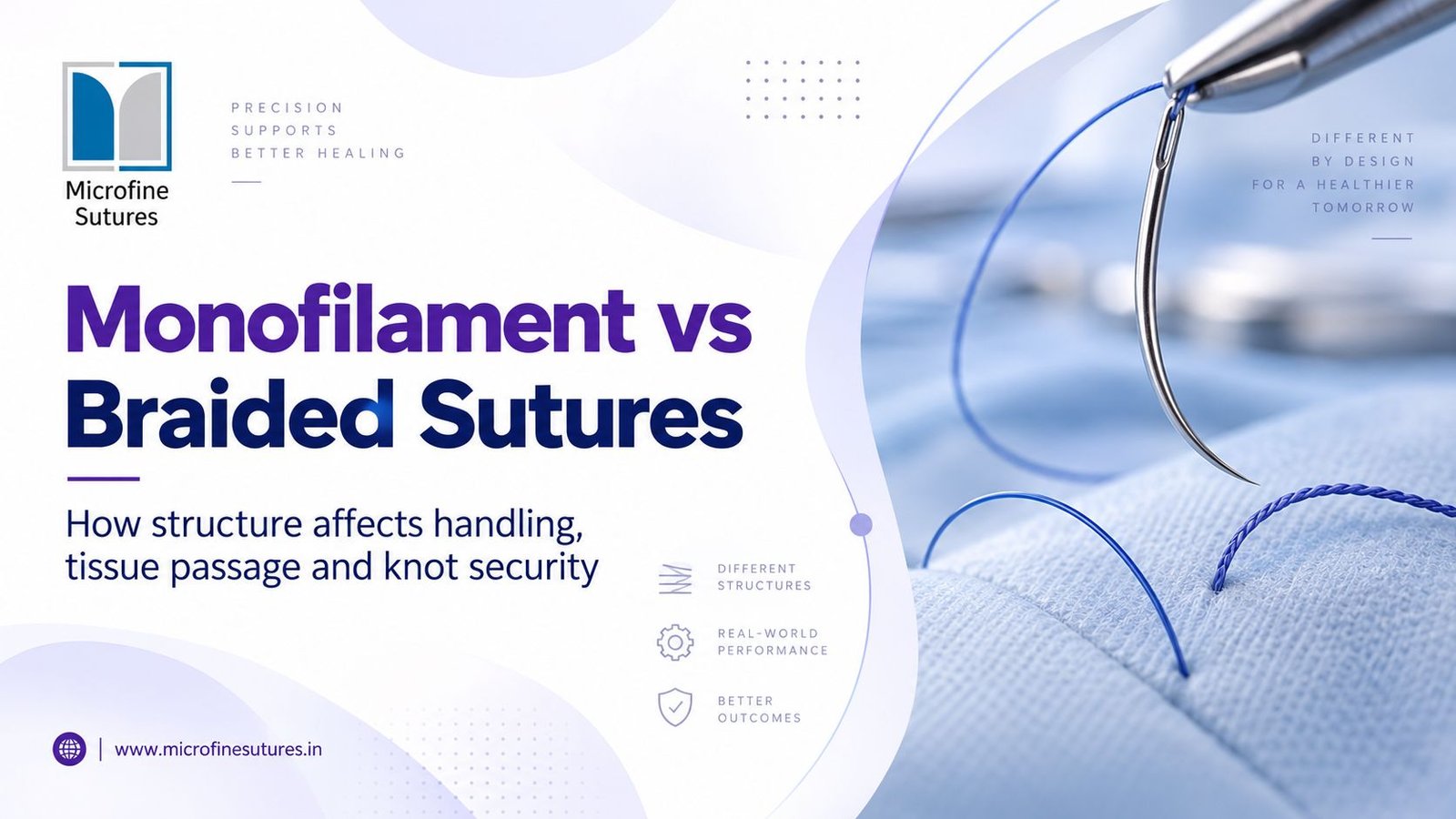
How Structure Affects Handling, Tissue Passage and Knot Security
Choosing the right surgical suture involves much more than deciding between an absorbable and a non-absorbable material. The physical structure of the suture also plays an important role in how it behaves during a surgical procedure.
One of the most important structural differences is whether the suture is monofilament or braided.
A monofilament suture is made from a single strand of material, while a braided suture consists of multiple fine filaments woven together. This difference can influence handling, tissue passage, flexibility, knot performance and the overall experience during suturing.
Microfine Sutures offers different monofilament and braided options across its surgical suture portfolio, allowing healthcare professionals and distributors to select products according to the requirements of different procedures.
What Is a Monofilament Suture?
A monofilament suture consists of a single continuous strand of material.
Because of its smooth surface, a monofilament suture generally passes through tissue with relatively low resistance. The single-strand construction also reduces spaces between fibres, which is one of the major structural differences compared with braided sutures.
However, depending on the material, monofilament sutures may have greater memory. This means the suture may tend to retain the shape in which it was packaged and may require careful handling during knot placement.
Examples from the Microfine range include:
- MicroLene – Monofilament Polypropylene Suture
- MicroLon – Monofilament Polyamide Suture
- MicroCryl Mono – Monofilament Polyglecaprone Suture
- MicroSynth PDO – Monofilament Polydioxanone Suture
These products differ in material composition, absorption characteristics and intended applications, even though they share a monofilament structure.
What Is a Braided Suture?
A braided suture is made by weaving several fine strands together to create a single surgical thread.
The braided construction generally makes the suture more flexible and easier to manipulate. This can support handling and knot placement during procedures where greater pliability is preferred.
Compared with monofilament sutures, braided sutures usually have a more textured surface. As a result, there may be more interaction between the suture and tissue during passage.
Microfine’s braided suture range includes products such as:
- MicroSynth – Polyglactin 910 Suture
- MicroCryl – Polyglycolic Acid Suture
- MicroBond – Braided Polyester Suture
Healthcare professionals and distributors can explore the complete Microfine surgical suture product range to understand the different materials, constructions and available options.
Monofilament vs Braided Sutures: Key Differences
| Feature | Monofilament Sutures | Braided Sutures |
|---|---|---|
| Structure | Single strand | Multiple woven strands |
| Surface | Smooth | More textured |
| Tissue passage | Generally lower tissue drag | Generally greater surface interaction |
| Flexibility | Depends on material; may have greater memory | Usually more flexible |
| Handling | May require careful manipulation | Generally easier to handle |
| Knot behaviour | Proper knot technique is important | Flexible structure can assist knot handling |
| Examples | MicroLene, MicroLon, MicroCryl Mono | MicroSynth, MicroCryl, MicroBond |
These are general structural characteristics. Actual performance also depends on the suture material, size, coating, needle configuration and surgical technique.
How Suture Structure Affects Handling
Handling is an important consideration during suturing because surgeons need to control the thread accurately while passing it through tissue and forming secure knots.
Handling of Monofilament Sutures
Monofilament sutures have a smooth single-strand structure.
Their smooth surface can support easy passage through tissue. However, some monofilament materials can have more memory than braided materials, which means they may require more controlled handling during knot formation.
For example, MicroLene is made from polypropylene and provides a non-absorbable monofilament option, while MicroCryl Mono provides an absorbable monofilament option based on Polyglecaprone.
Although both products have a monofilament structure, their material properties and absorption profiles are different.
Handling of Braided Sutures
Braided sutures are made from several filaments woven together.
This construction generally provides greater flexibility and pliability, which can make them easier to manipulate during suturing and knot placement.
MicroSynth, MicroCryl and MicroBond are examples of braided products within the Microfine portfolio.
MicroSynth and MicroCryl are absorbable options, while MicroBond is a non-absorbable braided polyester suture.
How Structure Affects Tissue Passage
The surface of a suture comes into direct contact with tissue during every pass of the needle and thread.
Because monofilament sutures have a smooth single-strand structure, they generally create less surface friction during tissue passage.
This can be useful where smooth passage through tissue is an important consideration.
Braided sutures, on the other hand, contain multiple filaments. Their woven surface can create greater friction when passing through tissue.
Some braided sutures are coated to improve handling and reduce surface friction.
Therefore, the choice between monofilament and braided construction should be considered together with the material and intended surgical application.
How Structure Influences Knot Security
Knot security is another important factor when selecting a surgical suture.
However, knot security does not depend only on whether a suture is monofilament or braided.
Several factors can influence knot performance, including:
- Suture material
- Suture diameter
- Surface characteristics
- Flexibility
- Number of knot throws
- Knot configuration
- Surgical technique
Braided sutures are generally more flexible and can provide good handling during knot formation because of their multifilament construction.
Monofilament sutures have a smoother surface and may require careful knot placement depending on the material being used.
This is why surgeons evaluate both the structural design and material properties of a suture instead of considering only one characteristic.
Monofilament Does Not Always Mean Non-Absorbable
A common misunderstanding is that monofilament sutures are always non-absorbable.
This is not correct.
Monofilament describes the physical structure of the suture, while absorbable or non-absorbable describes how the material behaves inside the body over time.
For example:
MicroLene is a monofilament non-absorbable polypropylene suture.
MicroLon is a monofilament non-absorbable polyamide suture.
MicroCryl Mono is a monofilament absorbable Polyglecaprone suture.
MicroSynth PDO is also an absorbable monofilament suture.
Similarly, braided sutures can also be either absorbable or non-absorbable.
MicroSynth and MicroCryl are braided absorbable sutures, whereas MicroBond is a braided non-absorbable polyester suture.
Therefore, structure and absorption profile should always be evaluated separately.
When Are Monofilament Sutures Considered?
Monofilament sutures may be considered when characteristics such as smooth tissue passage and single-strand construction are preferred.
Depending on the surgical requirement, Microfine offers several monofilament options including:
- MicroLene Polypropylene
- MicroLon Polyamide
- MicroCryl Mono Polyglecaprone
- MicroSynth PDO
The appropriate selection depends on factors such as tissue type, expected healing period, duration of wound support and the specific procedure.
When Are Braided Sutures Considered?
Braided sutures may be preferred when flexibility, handling and ease of knot manipulation are important considerations.
Microfine provides braided options including:
MicroSynth – Polyglactin 910
MicroCryl – Polyglycolic Acid
MicroBond – Polyester
These products provide different combinations of absorbability and material characteristics while maintaining a braided construction.
Microfine also manufactures a broad range of absorbable and non-absorbable sutures for different surgical requirements.
How to Choose Between Monofilament and Braided Sutures
There is no single suture structure that is suitable for every procedure.
Selection should be based on the complete clinical requirement rather than simply choosing between monofilament and braided construction.
Important considerations may include:
- Type of tissue being approximated
- Required duration of wound support
- Absorbable or non-absorbable requirement
- Tissue passage characteristics
- Handling preference
- Knot technique
- Suture size
- Needle type
- Material composition
- Surgical procedure
For example, a surgeon may prefer a smooth monofilament material for one procedure but choose a flexible braided suture for another.
The correct choice depends on the combination of material, structure and clinical requirement.
Microfine Sutures: Different Structures for Different Surgical Needs
Microfine Sutures offers a broad portfolio of surgical sutures manufactured using different materials and constructions.
Its range includes Polypropylene, Polyamide, Polyglecaprone, Polydioxanone, Polyglactin 910, Polyglycolic Acid and Polyester sutures.
This allows hospitals, surgeons, distributors and medical-device partners to choose between monofilament and braided options as well as absorbable and non-absorbable materials based on their specific requirements.
Conclusion
The difference between monofilament and braided sutures begins with their physical construction.
Monofilament sutures are made from a single strand and generally provide a smoother surface for tissue passage. Braided sutures contain multiple woven filaments and are typically more flexible and easier to manipulate.
Products such as MicroLene, MicroLon and MicroCryl Mono represent different monofilament options, while MicroSynth, MicroCryl and MicroBond represent braided alternatives.
Ultimately, suture selection should consider not only structure but also material, absorption profile, tissue requirements, needle configuration, knot technique and the intended surgical application.