Surgical sutures play a critical role in wound closure, tissue approximation and the healing process. The correct choice of suture depends on several factors, including the type of tissue, wound location, expected healing time, required tensile support and the surgeon’s preferred technique.
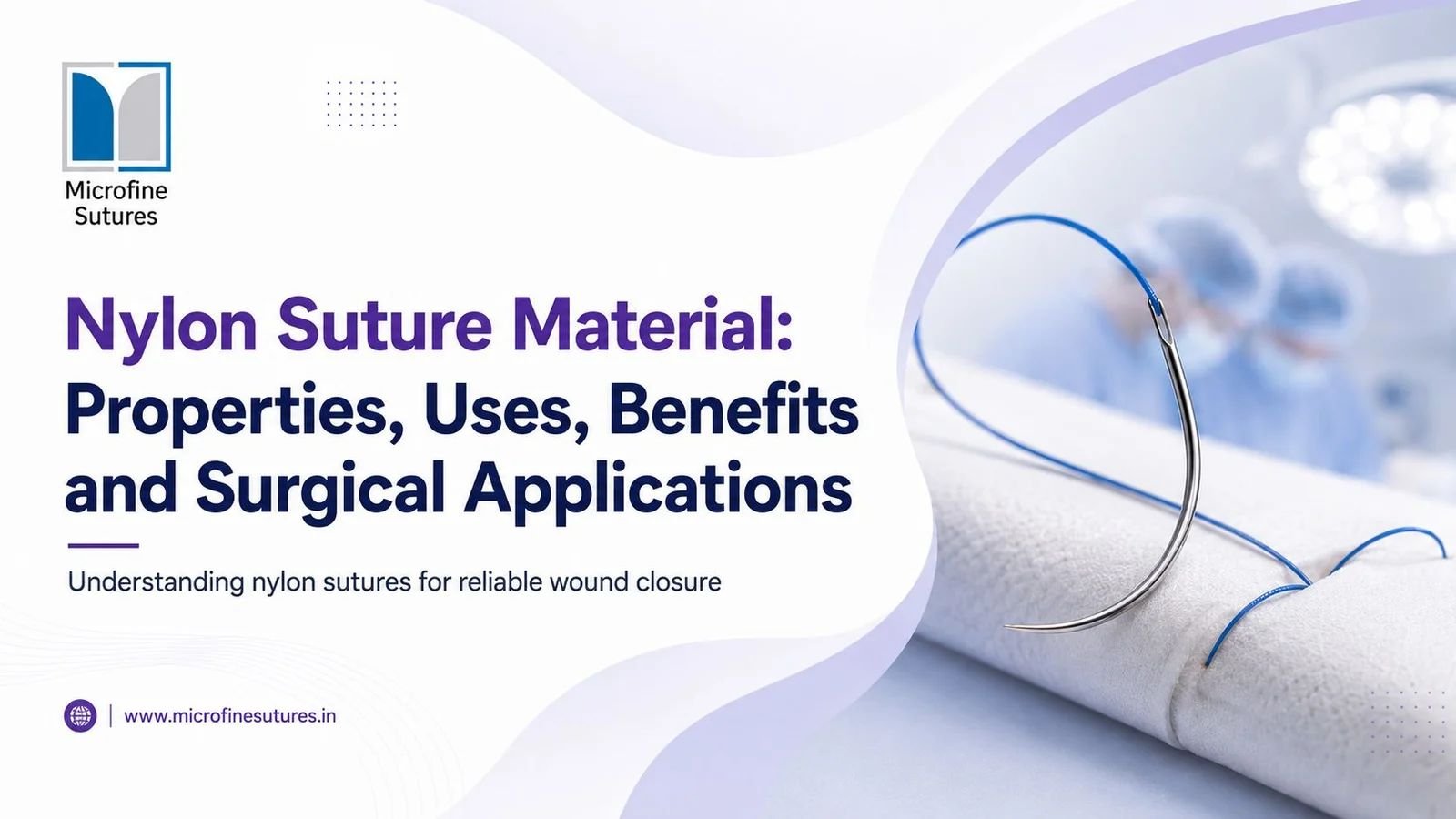
Among the commonly used non-absorbable sutures, the nylon 3/0 suture is widely selected for procedures that require a fine yet dependable suture material. Its smooth monofilament structure, reliable initial tensile strength and relatively low tissue reactivity make it suitable for a range of skin and soft-tissue closure applications. Nylon is a synthetic polyamide material and is generally classified as a non-absorbable monofilament surgical suture.
At Microfine Sutures, we provide reliable surgical suture solutions designed to support hospitals, clinics, surgeons, distributors and healthcare procurement partners.
What Is a Nylon 3/0 Suture?
A nylon 3/0 suture, also written as nylon 3-0 suture, is a synthetic, non-absorbable surgical suture manufactured from polyamide material.
The term 3/0 refers to the diameter or size of the suture under the USP sizing system. As the number of zeros increases, the diameter of the suture generally becomes finer. Therefore, a 3/0 suture is thinner than a 2/0 suture but thicker than a 4/0 suture.
Nylon 3/0 sutures are commonly manufactured as monofilaments, meaning that each suture consists of a single smooth strand. Monofilament construction generally creates less tissue resistance during passage than multifilament sutures and provides fewer spaces where microorganisms and fluids may collect.
Key Properties of Nylon 3/0 Suture
The clinical suitability of nylon 3/0 sutures comes from the characteristics of the material and its fine diameter.
1. Synthetic Polyamide Material
Nylon is a synthetic polymer from the polyamide family. Its manufactured composition provides consistent dimensions and dependable physical characteristics.
Synthetic sutures generally produce a more predictable tissue response than many naturally derived materials.
2. Non-Absorbable Suture
Nylon is classified as a non-absorbable suture material. It is resistant to rapid degradation by body tissues and may provide extended wound support.
When used for external skin closure, nylon sutures normally require removal after adequate healing, based on the surgeon’s clinical assessment. Non-absorbable sutures are commonly used for percutaneous wound closure and procedures requiring longer tissue stabilisation.
3. Monofilament Construction
A monofilament nylon suture is made from one continuous strand.
This structure provides:
- Smooth passage through tissue
- Relatively low tissue drag
- Reduced capillarity compared with braided materials
- Easier cleaning around external sutures
- Relatively low tissue reactivity
Monofilament sutures may require careful handling and additional knot throws because their smooth surface and memory can affect knot security.
4. Reliable Initial Tensile Strength
Nylon 3/0 sutures provide dependable initial strength to support wound approximation during the early stages of healing.
Although nylon is considered non-absorbable, its tensile strength may gradually reduce over a prolonged period. Therefore, its suitability should be evaluated according to the required duration of wound support.
5. Relatively Low Tissue Reaction
Nylon generally produces minimal cellular and inflammatory response compared with several natural suture materials. This is an important consideration in skin closure and procedures where controlling tissue irritation is desirable.
Common Uses of Nylon 3/0 Suture
The appropriate use of a nylon 3/0 suture depends on the wound, tissue characteristics, surgical technique and needle configuration.
It may be considered for:
- General skin closure
- Cutaneous and subcutaneous wound approximation
- Laceration repair
- Minor surgical procedures
- Plastic and reconstructive procedures
- Selected oral and maxillofacial procedures
- General soft-tissue approximation
- External interrupted suturing
- Procedures requiring later suture removal
Synthetic non-absorbable monofilament sutures, including nylon, are commonly used in cutaneous procedures.
The final choice of suture size and material must always be made by a qualified healthcare professional according to the clinical situation.
Why Is Nylon 3/0 Commonly Used for Skin Closure?
Skin closure requires a suture that can provide secure approximation while limiting unnecessary tissue irritation.
The nylon 3/0 suture offers several advantages for suitable skin wounds:
- Fine diameter for controlled wound approximation
- Smooth passage through skin
- Reliable initial tensile strength
- Relatively low tissue reaction
- Easy visibility when supplied in a dyed form
- Controlled removal after sufficient healing
Its monofilament structure may also reduce fluid absorption and tissue drag compared with braided sutures.
However, the most suitable suture size varies depending on the anatomical location, wound tension, skin thickness and cosmetic requirements. A 3/0 size may be appropriate for some closures but too large or too fine for others.
Advantages of Nylon 3/0 Suture
Smooth Tissue Passage
The smooth monofilament surface helps the suture pass through tissue with relatively low resistance. Reduced tissue drag can support precise placement and may help limit additional trauma during suturing.
Dependable Wound Approximation
Nylon 3/0 provides sufficient strength for many suitable external wound-closure procedures.
Low Capillarity
A single-strand structure has fewer spaces for fluid movement than a braided structure.
Relatively Low Tissue Reactivity
Synthetic nylon generally produces a limited tissue response, making it suitable for various skin and soft-tissue procedures.
Suitable for Removable Skin Sutures
When used externally, the suture can be removed after the wound has achieved sufficient healing.
Versatile Needle Combinations
Nylon 3/0 sutures may be supplied with different needle shapes and point geometries to support specific tissue and procedural requirements.
Nylon 3/0 Suture Needle Options
The performance of a suture depends not only on the thread but also on the attached surgical needle.
Common needle considerations include:
Reverse Cutting Needle
A reverse cutting needle is often selected for tougher tissues, including skin. Its cutting edge is positioned on the outer curvature, which can help reduce the risk of the needle cutting through the wound edge.
Conventional Cutting Needle
This needle may also be used for dense tissues, depending on the procedure and surgeon’s preference.
Taper Point Needle
Taper point needles are generally selected for softer tissues because they separate rather than cut tissue fibres.
Needle Curvature
Common curvatures may include:
- 3/8 circle
- 1/2 circle
- 5/8 circle
The appropriate needle type and curvature depend on tissue depth, access, surgical technique and wound location.
Nylon 3/0 vs Nylon 4/0 Suture
Both 3/0 and 4/0 nylon sutures are non-absorbable monofilament sutures, but they differ in diameter.
| Feature | Nylon 3/0 | Nylon 4/0 |
|---|---|---|
| Relative diameter | Thicker | Finer |
| Relative tensile capacity | Generally higher | Generally lower |
| Handling | More substantial | More delicate |
| Typical consideration | Wounds requiring greater support | Finer or more cosmetic closure |
| Tissue marking potential | May be more noticeable | May produce finer puncture sites |
The correct size should be based on the minimum diameter capable of supporting the wound without unnecessary tissue trauma.
Nylon 3/0 vs Polypropylene Suture
Nylon and polypropylene are both synthetic, non-absorbable monofilament suture materials, but they have different physical and handling characteristics.
Nylon
- Synthetic polyamide material
- Reliable initial tensile strength
- Commonly used for skin closure
- May gradually lose strength over time
- Can demonstrate material memory
Polypropylene
- Synthetic polyolefin material
- Retains long-term tensile strength
- Very low tissue reactivity
- Frequently selected for procedures requiring prolonged support
- Smooth tissue passage
The final choice depends on the required duration of support, tissue type and surgeon preference.
Nylon 3/0 vs Absorbable Sutures
The primary difference is whether the material is designed to remain in the body or gradually break down.
| Feature | Nylon 3/0 Suture | Absorbable Suture |
|---|---|---|
| Material category | Non-absorbable | Absorbable |
| Removal | Usually required for external closure | Generally not required |
| Support duration | Extended support | Temporary support |
| Common use | Skin and selected soft tissues | Internal tissues and mucosal closure |
| Degradation | Not rapidly absorbed | Degrades enzymatically or through hydrolysis |
Absorbable and non-absorbable sutures should not be treated as interchangeable. Their selection depends on tissue healing time and clinical requirements.
Factors to Consider When Selecting Nylon 3/0 Suture
Healthcare professionals should evaluate several factors before selecting a nylon 3/0 suture:
- Anatomical location
- Skin or tissue thickness
- Wound tension
- Required support duration
- Risk of infection or contamination
- Cosmetic expectations
- Needle type and curvature
- Suturing technique
- Patient age and healing capacity
- Planned time for suture removal
Using an unnecessarily thick suture may increase tissue marking, while a suture that is too fine may not provide sufficient wound support.
Important Handling Considerations
Monofilament nylon may exhibit memory, meaning it can retain the shape of its packaging.
During use, the surgeon should consider:
- Appropriate knot technique
- Adequate number of knot throws
- Avoiding excessive tension
- Proper wound-edge alignment
- Suitable spacing between sutures
- Avoiding overly tight knots that may compromise local circulation
The suture should be used according to the manufacturer’s instructions and accepted surgical practice.
Nylon 3/0 Sutures from Microfine Sutures
Microfine Sutures provides quality-focused surgical suture solutions for hospitals, healthcare facilities, wholesalers, distributors and international business partners.
Our nylon sutures are designed to support reliable handling and wound approximation across appropriate surgical applications.
Depending on availability and product configuration, our solutions may include:
- Nylon monofilament sutures
- Multiple USP sizes
- Different needle points and curvatures
- Sterile individual packaging
- Bulk supply options
- Distributor support
- OEM and private-label solutions
- Domestic and international supply
Why Choose Microfine Sutures?
Microfine Sutures is committed to providing dependable wound-closure products supported by consistent manufacturing and professional customer service.
Consistent Product Quality
We focus on maintaining uniformity across suture diameter, needle attachment, packaging and product presentation.
Multiple Suture Configurations
Different surgical procedures require different combinations of suture size, needle type and thread length.
Reliable Bulk Supply
We support hospitals, medical suppliers, wholesalers and distributors with scalable procurement solutions.
OEM and Private-Label Support
Healthcare brands and distributors can explore customised branding and packaging options according to business and regulatory requirements.
Global Supply Capabilities
Microfine Sutures supports domestic and international enquiries for surgical sutures and related wound-closure products.
Frequently Asked Questions About Nylon 3/0 Suture
What does 3/0 mean in nylon suture?
The term 3/0 represents the diameter of the suture under the USP sizing system. It is also commonly written as 3-0.
Is nylon 3/0 absorbable?
No. Nylon 3/0 is generally classified as a synthetic, non-absorbable surgical suture.
Is nylon 3/0 suitable for skin closure?
It may be suitable for selected skin closures, depending on the wound location, tissue thickness, tension and surgeon’s assessment.
Does nylon 3/0 need to be removed?
When used for external skin closure, nylon sutures generally require removal after adequate healing. The removal time varies by wound location and clinical progress.
Is nylon 3/0 a monofilament suture?
Nylon 3/0 is commonly manufactured as a monofilament suture, although nylon materials may also be available in other constructions.
What needle is commonly used with nylon 3/0?
A cutting or reverse cutting needle is commonly considered for skin, while other needle types may be used for different tissues and procedures.
Is nylon 3/0 suitable for internal tissues?
Its use depends on the procedure and clinical requirement. Because nylon is non-absorbable, the surgeon must determine whether long-term material retention is appropriate.
Conclusion
The nylon 3/0 suture is a versatile synthetic, non-absorbable suture commonly considered for skin and selected soft-tissue closure procedures.
Its fine diameter, dependable initial strength, smooth monofilament construction and relatively low tissue reactivity make it a practical wound-closure option when suitable for the clinical application.
Selecting the correct suture requires careful consideration of tissue type, wound tension, required support, needle configuration and healing expectations.
For hospitals, medical suppliers, distributors and healthcare brands seeking dependable nylon sutures, Microfine Sutures offers professional product support, bulk supply capabilities and customised business solutions.
Looking for a Reliable Nylon 3/0 Suture Manufacturer or Supplier?
Contact Microfine Sutures for nylon sutures, bulk procurement, distributor enquiries, OEM solutions, private-label manufacturing and global supply requirements.
Microfine Sutures – Precision in Every Strand. Confidence in Every Closure.
This article is intended for general product and educational information. Suture selection and use should be determined by qualified healthcare professionals according to the clinical procedure, approved indications and applicable instructions for use.