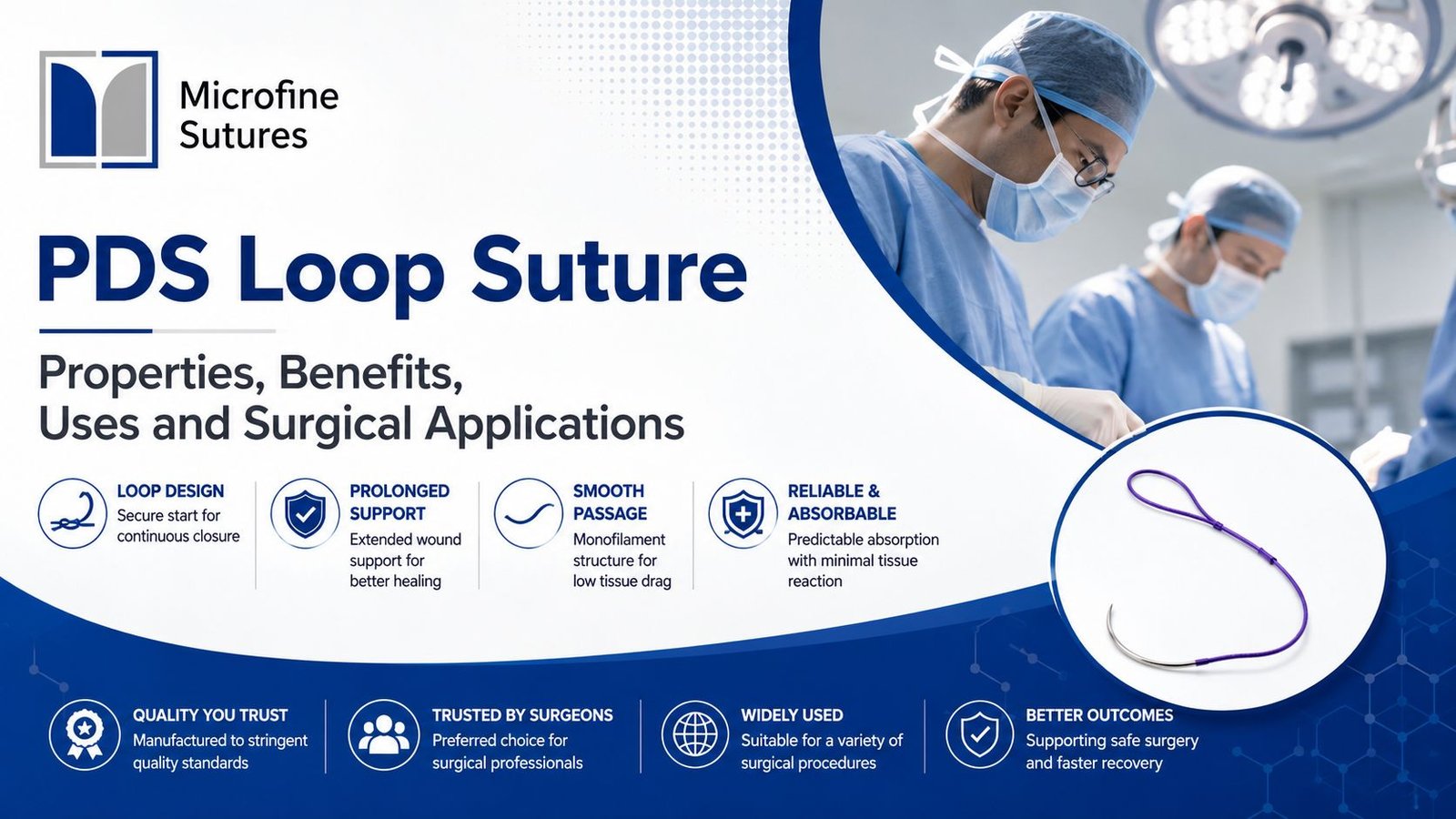
Reliable wound closure requires a suture that provides appropriate strength, secure tissue approximation and predictable absorption. In procedures where extended wound support is required, a PDS loop suture can offer surgeons an efficient and dependable closure option.
A PDS loop is generally a looped configuration of a synthetic, absorbable polydioxanone suture. Polydioxanone is commonly manufactured as a monofilament and is intended for general soft-tissue approximation where prolonged absorbable support may be beneficial.
At Microfine Sutures, we provide quality-focused surgical suture solutions designed to support hospitals, surgeons, healthcare facilities, wholesalers and medical distributors.
What Is a PDS Loop Suture?
A PDS loop suture is a long, continuous polydioxanone suture supplied in a looped configuration, usually attached to a surgical needle.
The loop design enables the surgeon to begin continuous closure without creating a conventional initial knot in certain techniques. This can simplify the beginning of the suturing process and provide a secure anchoring point.
The term PDS is commonly associated with polydioxanone, a synthetic polyester known chemically as poly(p-dioxanone). It is a sterile, absorbable monofilament material that is gradually broken down in the body through hydrolysis.
What Is Polydioxanone Suture Material?
Polydioxanone is a synthetic absorbable material developed for surgical procedures requiring longer wound support than many faster-absorbing sutures.
Its monofilament structure consists of a single smooth strand rather than multiple braided fibres. This construction provides smooth tissue passage and reduced capillarity compared with braided materials.
Polydioxanone sutures are particularly useful where an absorbable suture combined with extended wound support is required. FDA information for a widely used polydioxanone product describes support lasting for up to approximately six weeks in appropriate applications.
Understanding the Loop Configuration
In a conventional suture, the thread is supplied as a single strand. During continuous closure, the surgeon normally secures the first stitch with a knot before proceeding along the incision.
A loop suture has a loop at one end. After the first tissue pass, the needle and suture can be passed through this loop to create an anchoring point.
The loop configuration may provide several practical advantages:
- Simplified initiation of continuous closure
- Reduced need for a separate starting knot
- Secure initial anchoring
- Efficient use in long incisions
- Consistent distribution of tension
- Faster progression during continuous suturing
The surgeon must still follow the approved technique, product instructions and appropriate knotting or fixation method at the end of the closure.
Key Properties of PDS Loop Sutures
Synthetic Absorbable Material
PDS loop sutures are manufactured from synthetic polydioxanone. Synthetic composition helps provide consistent material properties and predictable absorption.
Monofilament Construction
The single-strand design creates a smooth surface that can pass through tissue with relatively low drag.
Compared with braided sutures, monofilament materials have fewer spaces where fluids and microorganisms may travel along the thread.
Extended Wound Support
Polydioxanone retains useful tensile strength for longer than many rapidly absorbing materials. This makes it suitable for tissues that heal gradually or require extended approximation.
Predictable Absorption
The material is gradually degraded through hydrolysis. This process allows the suture to provide temporary support and then progressively lose strength as the tissue heals.
Relatively Low Tissue Reaction
As a synthetic monofilament material, polydioxanone generally produces a limited tissue response compared with several natural suture materials.
Secure Loop Anchoring
The loop configuration can provide a convenient starting point for continuous suturing without requiring a bulky initial knot.
Benefits of PDS Loop Sutures
1. Efficient Continuous Closure
A PDS loop can make it easier to begin a continuous suturing technique. The needle is passed through the loop after the first tissue bite, creating a secure starting anchor.
This may save time when closing long incisions.
2. Prolonged Tissue Support
Some tissues, particularly fascia, may require support for several weeks while sufficient healing strength develops.
Polydioxanone is often considered where extended absorbable wound support is desirable.
3. Smooth Tissue Passage
The monofilament structure allows the suture to glide through tissue with limited friction and drag.
Smooth passage may help reduce unnecessary tissue trauma during closure.
4. Reduced Suture Bulk at the Starting Point
Because the loop can replace a conventional starting knot in suitable techniques, less knot material may remain at the beginning of the closure.
5. Consistent Tension Distribution
During continuous closure, the surgeon can distribute tension across the wound rather than concentrating it around multiple interrupted knots.
Appropriate tension must always be maintained to prevent tissue strangulation or inadequate wound-edge approximation.
6. Absorbable Support
A PDS loop provides temporary support and does not normally require manual removal when used internally according to its approved indications.
Common Uses of PDS Loop Sutures
PDS loop sutures may be considered for continuous closure in procedures involving tissues that require extended support.
Common applications may include:
- Abdominal wall closure
- Fascial closure
- Musculoaponeurotic tissue approximation
- General soft-tissue closure
- Laparotomy incision closure
- Selected orthopaedic soft-tissue procedures
- Paediatric procedures where prolonged absorbable support is needed
- Selected gastrointestinal closures
- Other long surgical incisions suitable for continuous closure
Polydioxanone sutures are intended for general soft-tissue approximation, but the exact indications and limitations depend on the manufacturer’s approved instructions for use.
PDS Loop for Fascial Closure
One of the most recognised applications of a PDS loop is abdominal fascial closure.
The fascia is a strong connective-tissue layer that contributes significantly to abdominal wall integrity. It heals more slowly than superficial skin and therefore may require a suture capable of maintaining support for an extended period.
A long-loop polydioxanone suture can be used in a continuous technique to approximate the fascial edges evenly across the incision.
Potential advantages in suitable fascial closure procedures include:
- Extended tensile support
- Even distribution of closure tension
- Efficient closure of long incisions
- Reduced number of knots
- Absorbable material remaining during the healing period
- Smooth passage through fascial tissue
The selection of suture size, needle type, bite spacing and closure technique should be determined by the surgeon.
PDS Loop vs Standard PDS Suture
Both products may be manufactured from the same polydioxanone material, but their configurations differ.
| Feature | PDS Loop Suture | Standard PDS Suture |
|---|---|---|
| Configuration | Loop at one end | Conventional single strand |
| Starting technique | May anchor through the loop | Usually requires an initial knot |
| Common closure style | Continuous closure | Continuous or interrupted closure |
| Efficiency | Useful for long incisions | Versatile for multiple techniques |
| Material | Polydioxanone | Polydioxanone |
| Absorption | Gradual hydrolytic absorption | Gradual hydrolytic absorption |
The appropriate configuration depends on the procedure and surgeon’s preferred technique.
PDS Loop vs Polyglactin 910 Suture
PDS and Polyglactin 910 are both synthetic absorbable materials, but they differ in structure and duration of support.
PDS Loop
- Polydioxanone material
- Usually monofilament
- Extended wound support
- Smooth tissue passage
- Commonly considered for fascia and slowly healing tissues
- Gradual absorption
Polyglactin 910
- Copolymer of glycolide and lactide
- Commonly braided and coated
- Flexible handling
- Strong knot security
- Generally absorbs faster than polydioxanone
- Commonly used for soft-tissue and mucosal closure
The choice should reflect the healing rate of the tissue and the required duration of mechanical support.
PDS Loop vs Polyglycolic Acid Suture
Polyglycolic acid is typically a braided absorbable suture, while PDS is usually a monofilament.
A braided polyglycolic acid suture may offer flexible handling and good knot security. A PDS loop may be selected when longer support, lower capillarity and monofilament passage are preferred.
Neither material is universally superior. The appropriate suture depends on the clinical application.
Needle Options for PDS Loop Sutures
A loop suture may be supplied with different surgical needle configurations.
Taper Point Needle
A taper point needle separates tissue fibres rather than cutting through them. It may be suitable for soft tissues and fascia.
Taper Cutting Needle
A taper cutting needle combines a tapered body with a cutting tip. It may be selected for dense or resistant tissue.
Needle Curvature
Common curvatures may include:
- 1/2 circle
- 3/8 circle
- Other procedure-specific curves
The appropriate needle depends on tissue thickness, surgical access, incision depth and the surgeon’s technique.
Important Factors When Selecting a PDS Loop
Healthcare professionals should consider several factors before choosing a looped polydioxanone suture:
- Tissue type
- Expected healing time
- Required duration of wound support
- Length of the incision
- Wound tension
- Suture size
- Needle point and curvature
- Continuous closure technique
- Risk of infection or contamination
- Patient-specific healing factors
The smallest suture size capable of maintaining reliable approximation is generally preferred to limit unnecessary foreign material.
Handling Considerations
Monofilament materials behave differently from braided sutures. Polydioxanone may demonstrate some memory and stiffness, particularly when first removed from its packaging.
Careful handling can help maintain performance:
- Open the sterile package using an aseptic technique
- Avoid crushing the suture with surgical instruments
- Do not kink or sharply bend the monofilament
- Maintain appropriate tension during continuous closure
- Avoid overtightening the tissue
- Use the recommended finishing technique
- Follow the product’s instructions for use
- Discard opened or unused sterile sutures as directed
Official product information also advises against resterilising opened or unused sutures and recommends following the complete instructions for use.
Limitations and Clinical Considerations
A PDS loop is not appropriate for every surgical procedure.
Important considerations may include:
- Monofilament memory can influence handling
- Continuous closure requires proper tension management
- Incorrect technique may cause uneven approximation
- The suture should not be used outside its approved indications
- Long-term permanent support may require a non-absorbable material
- Infection, poor tissue quality or excessive tension may affect closure outcomes
Some polydioxanone products are not indicated for adult cardiovascular tissue, microsurgery or neural tissue. Product-specific restrictions must always be confirmed in the applicable instructions for use.
PDS Loop Sutures from Microfine Sutures
Microfine Sutures provides surgical wound-closure products for healthcare institutions, surgeons, wholesalers, distributors and global medical-supply partners.
Our focus is on dependable manufacturing, consistent product quality and configurations suited to different surgical requirements.
Depending on availability and approved product specifications, our surgical suture portfolio may support:
- Synthetic absorbable sutures
- Monofilament suture options
- Looped suture configurations
- Multiple USP sizes
- Different suture lengths
- Procedure-specific surgical needles
- Sterile individual packaging
- Bulk procurement
- OEM and private-label requirements
- Domestic and international distribution
Why Choose Microfine Sutures?
Consistent Manufacturing Quality
Surgical sutures require close control over thread diameter, tensile properties, needle attachment, sterility and packaging integrity.
Reliable Product Configurations
Different procedures require different combinations of suture material, size, thread length and needle design.
Bulk Supply Support
Microfine Sutures supports procurement requirements for hospitals, medical suppliers, wholesalers and distributors.
OEM and Private-Label Solutions
Healthcare businesses can explore customised product branding and packaging according to regulatory and commercial requirements.
Global Business Support
We work with domestic and international partners seeking reliable surgical sutures and wound-closure products.
Frequently Asked Questions About PDS Loop Sutures
What is a PDS loop?
A PDS loop is a looped synthetic absorbable polydioxanone suture commonly used for continuous soft-tissue or fascial closure.
Is a PDS loop absorbable?
Yes. Polydioxanone is an absorbable material that gradually breaks down through hydrolysis.
What is the purpose of the loop?
The loop can create a secure starting anchor during continuous closure, reducing the need for a conventional initial knot in suitable techniques.
Is a PDS loop monofilament or braided?
Polydioxanone sutures are generally manufactured as monofilaments.
Where is a PDS loop commonly used?
It may be used for abdominal wall, fascial and general soft-tissue closure when extended absorbable wound support is required.
Does a PDS loop require removal?
When properly used internally, absorbable polydioxanone sutures generally do not require manual removal.
Is PDS suitable for permanent support?
No. Although polydioxanone provides prolonged support, it is absorbable and is not intended to provide permanent mechanical support.
What needle is used with a PDS loop?
A PDS loop may be supplied with taper point, taper cutting or other procedure-specific needles. The appropriate configuration depends on the tissue and surgical technique.
Conclusion
A PDS loop suture combines the prolonged wound support of polydioxanone with the convenience of a looped configuration.
Its synthetic absorbable composition, smooth monofilament structure and secure starting loop make it a practical option for selected continuous closure procedures, particularly where tissues require extended healing support.
The final selection of suture size, needle type and closure technique should always be made by a qualified healthcare professional according to the clinical procedure and applicable instructions for use.
For hospitals, medical suppliers, importers and distributors seeking dependable surgical sutures, Microfine Sutures offers quality-focused wound-closure solutions, bulk supply support and customised business opportunities.
Looking for a Reliable PDS Loop Suture Manufacturer or Supplier?
Connect with Microfine Sutures for PDS loop sutures, synthetic absorbable sutures, bulk procurement, distributor enquiries, OEM manufacturing, private-label solutions and international supply requirements.
Microfine Sutures – Reliable Support for Confident Surgical Closure.
This article is intended for general product information and professional education. Suture selection and use must be determined by qualified healthcare professionals according to the approved indications and relevant instructions for use.